Creatine Supplement Label Math: 3-5 g a Day and a 6-Step Label Check
Harvard Health's general recommendation is 3 to 5 g of creatine monohydrate a day, and a label is worth buying only if it lists the grams per scoop. At Thorne's listed $44 for 90 scoops, that works out to $0.49 for a 5 g day.
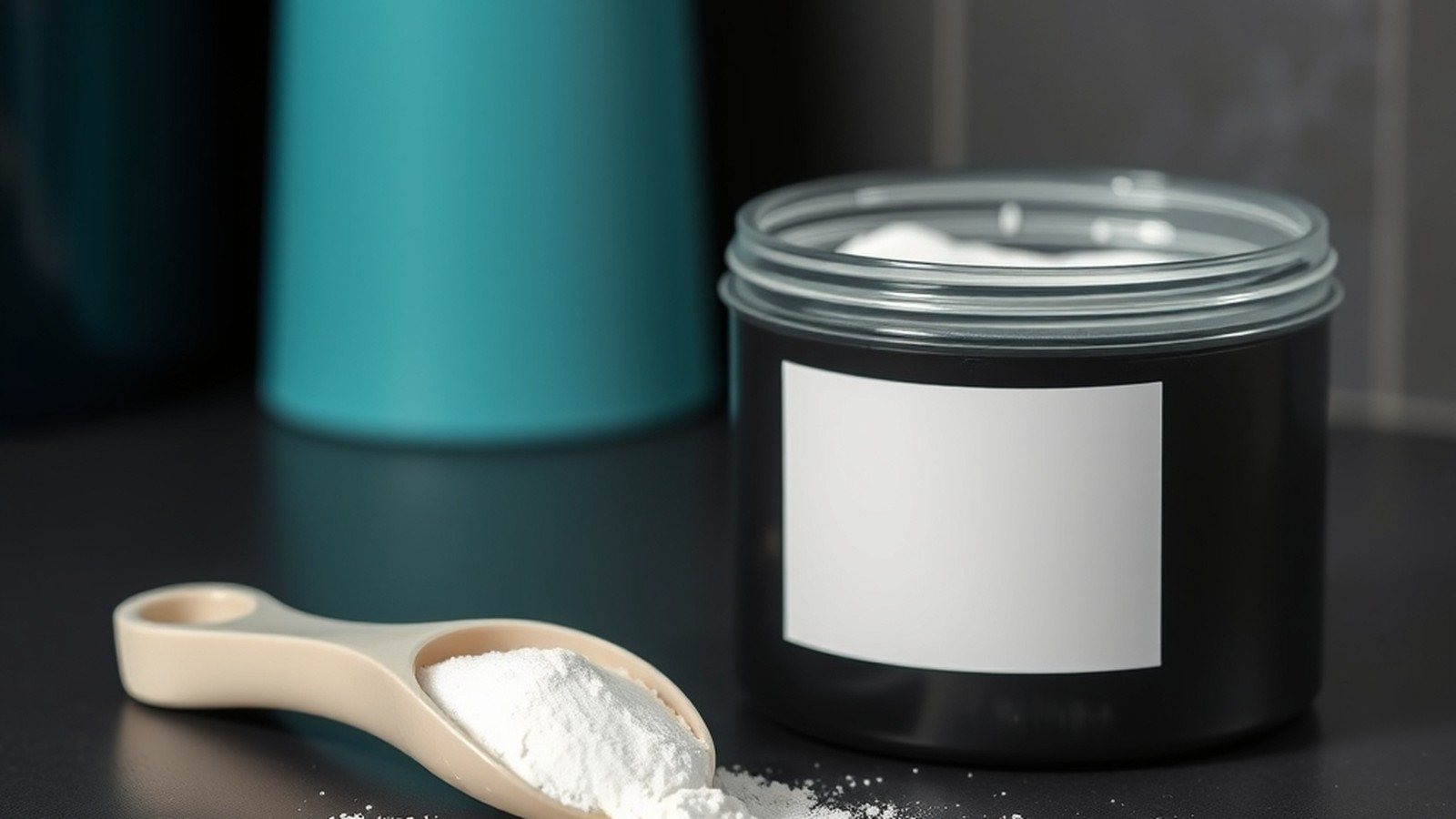
Buy plain creatine monohydrate, and read the grams per scoop.
A creatine supplement label is worth paying for only when it shows how many grams of monohydrate each scoop holds. Harvard Health gives the general recommendation as 3 to 5 g a day. From the grams per scoop you can work out how many scoops reach that range and what one day costs. For example, Thorne lists $44 for 90 scoops of 5 g (as listed in October 2026).
That works out to $44 ÷ 90 = $0.49 for a 5 g day.
Evidence summaries back short power bursts most; other findings are modest
Your body already makes creatine from three amino acids: arginine, glycine and methionine, according to Harvard Health. A supplement adds to stores your body already keeps. The strongest finding covers a narrow use. Harvard says creatine helps the body produce energy quickly and may enhance short bursts of power or speed.
Beyond that, the summaries add conditions. Harvard reports some evidence for faster recovery, and for offsetting age-related muscle loss when creatine is combined with resistance training. A Cedars-Sinai research dietitian says the research beyond athletes “is still evolving and results are mixed, but there does seem to be a potential role for creatine outside of the gym.” On executive function (the thinking skills used to plan and organize), Cedars-Sinai says newer trials report “modest but potentially meaningful improvements.”
So the evidence is strongest for short bursts and mixed beyond them. None of it predicts what any one person will notice.
Who starts from a lower base: Cedars-Sinai notes that vegetarians and vegans tend to have lower baseline creatine stores because of their diet.
Monohydrate at 3-5 g a day is the dose the sources back; loading is optional
The sources agree on the dose. Harvard’s general recommendation is 3 to 5 g a day, and it says other forms “do not offer any extra benefits” over monohydrate. Thorne’s label sits at the top of that range: its direction is 1 scoop (5 g) once daily.
Loading means taking larger amounts for a short stretch before settling on a daily dose. Thorne says a short loading phase builds creatine stores more quickly but is not required. Harvard Health goes further: it says loading “offers no advantages” and puts more stress on the kidneys. Neither source calls it necessary.
Timing barely matters. Thorne says creatine can be taken 30-90 minutes before or after exercise, or daily for consistent use. On those directions, taking it every day matters more than when you take it.
Two objections come up early, and both have sourced answers:
- Water weight. Harvard Health says some people retain a couple of pounds of fluid in the first week, and that this is temporary. Thorne’s page also says some people notice mild water retention when they start.
- Waiting. Thorne, which makes the product, says creatine “typically begins to work within 2-4 weeks of consistent daily use.”
Reading a creatine label: grams of monohydrate per scoop set the cost per day
Two lines of arithmetic do the job:
- Scoops needed = target grams ÷ grams of monohydrate per scoop
- Cost per day = tub price ÷ scoops per tub × scoops needed
Here they are applied to one real label and two kinds of label. Thorne’s figures come from its product page: $44 for 90 scoops, as listed in October 2026.
| Label | Monohydrate per scoop | Scoops to reach 3 g / 5 g | Cost per day |
|---|---|---|---|
| Thorne Creatine, $44 for 90 scoops (Thorne) | 5 g | 3 ÷ 5 = 0.6 / 5 ÷ 5 = 1 | $44 ÷ 90 = $0.49 for 5 g (1 scoop, the label direction); $0.49 × 0.6 = $0.29 for 3 g, only if you measure out 0.6 of a scoop |
| Any label listing 3 g per scoop (Harvard’s low end) | 3 g | 3 ÷ 3 = 1 / 5 ÷ 3 = 1.67 | its price ÷ its scoops × 1.67 for 5 g |
| A blend label that gives no grams for creatine | not stated | cannot compute | cannot compute |
Thorne’s label is built around one full 5 g scoop, so $0.49 is what a day costs as directed. The $0.29 figure assumes you measure part of a scoop yourself. A 3 g scoop passes, because one scoop reaches the low end of Harvard’s range. A label that gives no grams for creatine fails, because you cannot work out scoops or cost per day.
Other supplements have the same gap between the big number on the tub and the dose of the active ingredient. One example is omega-3 eicosapentaenoic acid (EPA) and docosahexaenoic acid (DHA) labels. The label math series runs this arithmetic on other ingredients.
The flaw in every row: the grams are the brand’s own claim. Harvard Health notes that the U.S. Food and Drug Administration (FDA) does not regulate the accuracy of supplement contents. So a tub can contain “less or more than the amount on the label.” Outside certification covers part of that gap. Thorne’s page says its creatine is NSF Certified for Sport, and that this mark means the product “has been tested for compliance with label claims.”
Skip any label that does not give creatine’s grams on their own line. Instead, buy a single-ingredient monohydrate that lists its grams and carries a third-party seal.
Safety: large reviews found no kidney or liver harm in healthy adults at recommended doses
Cedars-Sinai says creatine monohydrate has one of the strongest safety profiles of any dietary supplement. It adds that large reviews found no increased risk of kidney or liver damage at recommended doses in healthy adults. That finding does not cover everyone, and Cedars-Sinai says directly that creatine is not appropriate for everyone.
Based on the sources, these people should check with a clinician first:
- People with kidney problems. Harvard Health flags existing kidney problems as a reason for caution.
- People who are pregnant or breastfeeding. Thorne’s own label carries a pregnancy warning. NIH’s Office of Dietary Supplements urges caution with supplements during pregnancy and breastfeeding.
- Children. NIH’s Office of Dietary Supplements says to be careful about giving supplements to a child unless their health care provider recommends it. Separately, Thorne’s page notes that New York law bars selling the product to anyone under 18. That is a sales restriction, not a safety finding.
Related reading: When Should You Take Creatine.
A creatine label passes only if it names monohydrate, lists its grams, reaches 3-5 g in one or two scoops and carries a third-party seal
One flaw sits under every check: per Harvard Health, the FDA does not regulate the accuracy of supplement contents. That is why check 5 asks for a seal. A label that passes all six checks is the one to buy.
- The form says “creatine monohydrate.” The safety record Cedars-Sinai describes is for monohydrate, and Harvard says other forms add no extra benefit.
- Creatine’s grams appear on their own line. If the label gives no grams for creatine itself, put the tub back.
- One or two scoops reach 3-5 g, and loading is not required. Divide 3 and 5 by the grams per scoop: a 3 g or 5 g scoop passes. Directions that insist on loading go further than Thorne, which calls it optional.
- You can work out the cost per day. Use tub price ÷ scoops per tub × scoops per day. Thorne’s $0.49 per 5 g day is one benchmark to compare against.
- The label carries a third-party seal. Thorne’s page says NSF Certified for Sport means a product “has been tested for compliance with label claims.”
- Food comes first, and a clinician comes first if a safety group applies to you. NIH’s Office of Dietary Supplements says supplements cannot replace a varied diet. If you are in one of the groups listed under Safety above, check with a clinician before you start.
This is general information from public sources, not medical advice.
Sources
- https://www.health.harvard.edu/exercise-and-fitness/what-is-creatine-potential-benefits-and-risks-of-this-popular-supplement
- https://www.thorne.com/products/dp/creatine
- https://www.cedars-sinai.org/stories-and-insights/healthy-living/should-you-take-creatine-what-to-know-before-you-supplement
- https://ods.od.nih.gov/factsheets/WYNTK-Consumer/